 Find a Doctor
 Locations
  Services
You Inspire The Best in Us.
With the many advances in care and treatments, today’s patients have more and more reasons to expect the best outcomes. Here are the incredible stories of our patients and their journeys. Click on a thumbnail and scroll down to view each story.



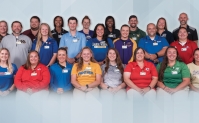


Strength on the Sidelines
By Leslie A. Mikell
It is a Friday night in South Carolina, and stadium lights are shining bright on the high school football teams competing on the field. The marching band is playing in the stands, and the cheerleaders have the crowd on their feet. Suddenly, everything comes to a stop and a silence falls over the crowd. An athlete is down on the field, not moving.
Someone from the sideline rushes to the middle of the field and is by the athlete’s side. They carefully assess the athlete, checking their limbs and neck. Then, they help the athlete to their feet, and the crowd applauds while the athlete is walked off the field.
Afterward, on the sideline, the athlete undergoes a more thorough medical evaluation. Who is the person taking care of the student athlete?
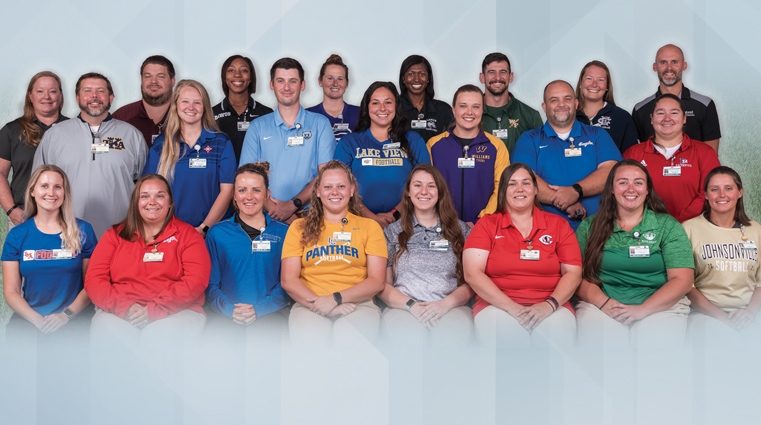
From Lake City to Dillon, Florence to Conway, and Manning to Cheraw, McLeod Sports Medicine Certified Athletic Trainers provide care for student athletes in schools and on the sidelines.
Certified Athletic Trainers (ATCs) are allied health professionals who are experts in injury prevention, assessment, treatment and rehabilitation, particularly in the orthopedic and musculoskeletal disciplines. ATCs are also involved in healthcare administration, nutrition, biomechanics, education, counseling, physiology, psychology and conditioning to enhance athletic performance.
“Currently, McLeod Sports Medicine has more than 35 Certified Athletic Trainers working in more than 31 schools across northeastern South Carolina,” states Adam Ploeg, Director of McLeod Sports Medicine and Rehabilitation.
“We provide Athletic Training and Sports Medicine services to both local public and private high schools, middle schools as well as two collegiate programs.
“Our highly qualified Sports Medicine team has Athletic Trainers who hail from all over the United States,” Adam mentions. “Many have master’s degrees, and several others also hold additional certification and training as Emergency Medical Technicians (EMTs).”
Having a Certified Athletic Trainer on site ensures a safe environment for athletic participation. The ATC works to prevent athletic injuries and cares for the students if injuries occur. With their presence in the schools, at practices and games, the ATCs build relationships with coaches, student athletes and their parents by creating a culture of trust and communication. Students can come to their athletic trainer with not just injuries, but for help with problems off the field as well.
-
McLEOD REGIONAL MEDICAL CENTER FLORENCE
843-777-2000 -
McLEOD DARLINGTON
843-777-1100 -
McLEOD DILLON
843-774-4111 -
McLEOD LORIS
843-716-7000 -
McLEOD SEACOAST
843-390-8100 -
McLEOD CHERAW
843-537-7881 -
McLEOD CLARENDON
803-433-3000



-
McLEOD REGIONAL MEDICAL CENTER FLORENCE
843-777-2000 -
McLEOD DARLINGTON
843-777-1100 -
McLEOD DILLON
843-774-4111 -
McLEOD LORIS
843-716-7000 -
McLEOD SEACOAST
843-390-8100 -
McLEOD CHERAW
843-537-7881 -
McLEOD CLARENDON
803-433-3000