 Find a Doctor

 Locations
 Services


 Print This Page
Seeing Beyond the Scan: What Radiologists Want You to Know About Breast Cancer
By W. Shawn Conwell, MD
The two largest risk factors for breast cancer are being a woman and getting older, and neither one is optional. About 85 percent of breast cancers occur in women with no family history of the disease. I hear the same sentence in Breast Imaging every week: it doesn’t run in my family. A clean family tree is not a shield. It is simply the most common history a breast cancer patient has.
Women are also rarely told that not every screening schedule is equivalent. We recommend an annual mammogram beginning at age 40 for average risk women. Modeling published in Radiology in 2024 estimated that annual screening from 40 to 79 reduces breast cancer deaths by about 42 percent, compared with roughly 30 percent for screening every other year from 40 to 74.
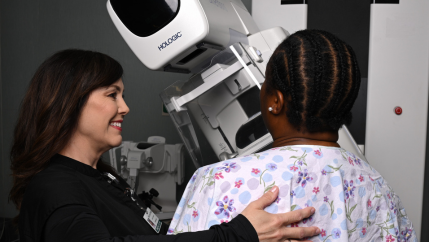
A screening mammogram takes about fifteen minutes and can detect a cancer the size of a grain of rice, years before anyone could feel it.
Barriers affecting the screening, diagnosis and treatment of breast cancer in the region include distance and cost. Distance is the obvious barrier, but it is rarely the whole story. In the rural Pee Dee counties we serve, a woman may live an hour or more from a breast center, with one vehicle in the household and an hourly job that does not pay her for the day she misses. Now ask her to make that drive three separate times: once for the mammogram, once for the ultrasound, and once for the biopsy and she stops coming. One way we are trying to ease this burden involves compressing the work-up and the biopsy into a single visit when the imaging scans make cancer appear highly likely.
The second barrier is cost, and it is not where most people assume. The screening mammogram is usually covered. The work-up after an abnormal result often is not. Depending on a woman’s insurance plan, the cost of an ultrasound or MRI to determine if it is cancer can be affected by whether she has met her deductible causing some women to decline to pursue further testing because of the out-of-pocket expense.
Offering breast imaging services in our rural hospitals and the McLeod Mobile Mammography Unit, which goes to industries throughout the region, are expanding access to care. And every woman should know about the Best Chance Network, which covers screening for uninsured and underinsured women in the state.
In South Carolina, African American women are slightly less likely to be diagnosed with breast cancer than Caucasian women, and substantially more likely to die of it: roughly 28 deaths per 100,000 women compared with about 20. That gap has held steady long enough that we should stop describing it as surprising and start treating it as a finding.
What concerns me most is where the gap does not come from. In our state, African American women ages 40 to 64 report having had a recent mammogram at a higher rate than Caucasian women. Getting women screened is not primarily a problem. The gap opens after the abnormal mammogram: in the days it takes to get a biopsy, the time to a first oncology visit, and whether the full course of treatment is finished. Biology contributes as well, since triple-negative breast cancer is both more common and more aggressive in African American women.
In closing, I would say the following to women:
- To the woman putting off the screening: I know exactly why. You are afraid of what we might find, you are carrying everyone else’s schedule, and nothing feels wrong. All three are real, and none of them changes what the tumor is doing while you wait. It is fifteen minutes. Make the call this week. The most likely thing that happens next is that we call to tell you it is normal. That is how it goes more than nine times out of ten.
- To the woman who just heard the words you have breast cancer: what you are feeling in this moment is not a preview of your next year. Nearly everything about this is more treatable than what you are picturing, most cancers detected on screening are found early, and you will not do this alone. Ask for a nurse navigator on day one, and write your questions down, because you will not remember them once your are in the exam room.
- To the breast cancer survivor: the part no one warns you about is that finishing treatment can feel harder than being in it. The appointments stop, the structure disappears, and the fear does not. That is normal and it is common, and it is worth saying it out loud to someone who can help.
Board Certified in Radiology, Dr. W. Shawn Conwell received his medical degree from the Medical College of Georgia in Augusta, Georgia, and completed a residency in Radiology at Case Western Reserve University in Cleveland, Ohio. Dr. Conwell also completed a fellowship in Breast and Women’s Imaging from Magee Women’s Hospital at the University of Pittsburgh in Pittsburgh, Pennsylvania. Dr. Conwell serves as the Cancer Liaison Physician to the American College of Surgeons’ Commission on Cancer for McLeod Regional Medical Center. He is also the Medical Director of McLeod Health’s Women’s Oncology Service Line and Chair of the McLeod NAPBC-accredited Breast Program.
-
McLEOD REGIONAL MEDICAL CENTER FLORENCE
843-777-2000 -
McLEOD DARLINGTON
843-777-1100 -
McLEOD DILLON
843-774-4111 -
McLEOD LORIS
843-716-7000 -
McLEOD SEACOAST
843-390-8100 -
McLEOD CHERAW
843-537-7881 -
McLEOD CLARENDON
803-433-3000



-
McLEOD REGIONAL MEDICAL CENTER FLORENCE
843-777-2000 -
McLEOD DARLINGTON
843-777-1100 -
McLEOD DILLON
843-774-4111 -
McLEOD LORIS
843-716-7000 -
McLEOD SEACOAST
843-390-8100 -
McLEOD CHERAW
843-537-7881 -
McLEOD CLARENDON
803-433-3000
