 Find a Doctor

 Locations
 Services


 Print This Page
Aneurysms Are You At Risk?
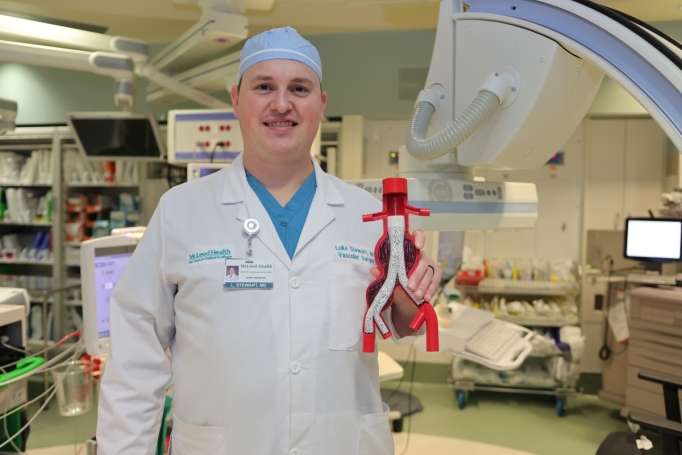
by Dr. Luke Stewart
McLeod Vascular Surgeon
An aneurysm is a bulging or ballooning of an artery that is greater than 50 percent of the normal width of the artery. The most common aneurysm, the abdominal aortic aneurysm, is in the aorta, the main blood vessel in the body. It carries blood from the heart, all the way to the organs in the stomach, down to the legs.
If an abdominal aortic aneurysm were to rupture, it could potentially cause significant bleeding possibly even leading to death. To prevent rupture, aneurysms are repaired when they reach a certain size. For a female, it is five centimeters, and for a male, it’s 5.5 centimeters.
Currently, aneurysms cannot be prevented. What causes them to form isn’t exactly known.
The biggest risk factors for aneurysms are smoking and family history. About 75 percent of abdominal aortic aneurysms occur in patients with a history of smoking, according to the U.S. Centers for Disease Control and Prevention. With a family history, you are at a higher risk if your mother, father, brother, or sister had an aneurysm.
The more common way to find an aneurysm is during a non-related MRI or CT scan. The patient would then be referred to a Vascular Surgeon for further evaluation and treatment.
The first step in treatment is to check the size of the aneurysm. If it is below the threshold size for repair, a monitoring program is established for the patient to see one of our four Vascular Surgeons. If the aneurysm meets the size for repair, then there is a discussion regarding the repair options.
The classic option is an open aortic aneurysm repair. This requires an abdominal incision and the sewing in of a graft to replace the aortic aneurysm.
Today, our preferred treatment for most patients is a minimally invasive option, the endovascular method. This involves a stent graft, a tube designed to keep the passageway open to allow normal flow of blood. The graft, made of fabric and metal wire to reinforce the weak spot, is sewn inside the aneurysm. Blood flows through the graft and prevents the aneurysm from growing.
The endovascular approach has revolutionized treatment. Previously, with the large abdominal incision required, patients were in the hospital for a prolonged period. Now with the endovascular technique, patients go home often the next day, and their recovery is quicker.
The endovascular method works when the aneurysm is located far enough from the kidney arteries, which branch off the aorta, so the stent can be securely attached to the aorta.
For patients who are not a candidate for the traditional endovascular method of treatment, another option is available at McLeod. Fenestrated Endovascular Aortic Repair (FEVAR) is a form of endovascular surgery using a custom-designed graft.
Because an aneurysm involves the major blood vessels from the aorta that feed the kidneys, intestines, and liver, the stent graft from the traditional method cannot be used as it blocks the blood flow to the organs.
The FEVAR graft is designed with holes (fenestrations) that correspond to the unique positioning of the arteries in the body that branch off from the aorta to the organs.
Once the fenestrated endograft is implanted, blood can flow through the diseased area without putting pressure on the aneurysm, and the holes in the graft allow blood flow to continue to the vital organs.
If you are concerned about an abdominal aortic aneurysm, speak with your primary care physician about a referral to McLeod Vascular Associates.
McLeod Vascular Surgeon Dr. Luke Stewart is a skilled physician with vascular surgery fellowship training. Dr. Stewart cares for patients at McLeod Vascular Associates in Florence.
-
McLEOD REGIONAL MEDICAL CENTER FLORENCE
843-777-2000 -
McLEOD DARLINGTON
843-777-1100 -
McLEOD DILLON
843-774-4111 -
McLEOD LORIS
843-716-7000 -
McLEOD SEACOAST
843-390-8100 -
McLEOD CHERAW
843-537-7881 -
McLEOD CLARENDON
803-433-3000



-
McLEOD REGIONAL MEDICAL CENTER FLORENCE
843-777-2000 -
McLEOD DARLINGTON
843-777-1100 -
McLEOD DILLON
843-774-4111 -
McLEOD LORIS
843-716-7000 -
McLEOD SEACOAST
843-390-8100 -
McLEOD CHERAW
843-537-7881 -
McLEOD CLARENDON
803-433-3000
