 Find a Doctor
 Locations
  Services

 Print This Page
 McLeod Celebrates 400th TCAR Procedure
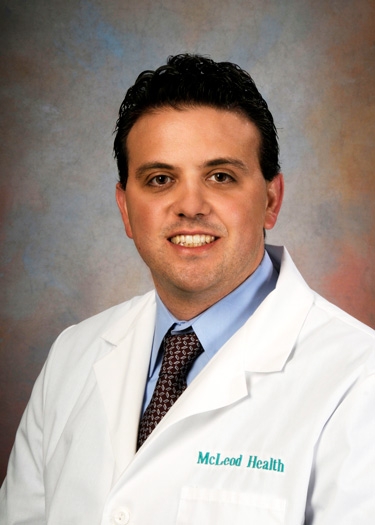
McLeod Vascular Surgeon Dr. Carmen Piccolo, along with the operating room team, recently completed their 400th TCAR procedure. This procedure, offered at McLeod Regional Medical Center and McLeod Health Seacoast since 2017, is a minimally invasive carotid artery treatment which reverses the blood flow to keep blood clots away from the brain to prevent a stroke.
A stroke occurs when a part of the brain loses its blood supply and stops working. The part of the body that the injured brain controls stops working as well. Approximately 795,000 people in the United States will have a stroke each year, according to the American Stroke Association.
The most common type of stroke is an Ischemic stroke, which accounts for 80 to 90 percent of strokes. An Ischemic stroke is when the arteries to the brain become so narrowed or blocked that the blood flow is severely reduced. An estimated 20 to 30 percent of Ischemic strokes are caused by disease in the carotid arteries.
The carotid arteries, the main arteries to the brain, carry blood flow on each side of the neck up into the brain. Their function is to provide oxygen.
Over time, some people develop problems with the arteries to their brain in the form of blockages. As plaque builds up in the walls of their carotid arteries, eventually it reduces the blood flow through the arteries. If those blockages get severe enough it can cause a stroke.
Carotid artery disease is a serious issue. Blood clots can form on the plaque, and if a clot or a piece of plaque breaks loose and travels to the brain it can block the blood flow to that portion of the brain.
Carotid endarterectomy is a procedure performed by a Vascular Surgeon to treat carotid artery disease. During this procedure, the Vascular Surgeon exposes the carotid artery through an incision on the side of the neck. The artery, after being clamped on both sides of the blockage, is then opened to access the plaque. The plaque is removed from inside the artery and the artery is then sewn back together.
This is an effective treatment for decreasing the risk of stroke. However, some patients have medical conditions that place them at high risk for an open procedure like carotid endarterectomy.
For these patients, Transcarotid Arterial Revascularization (TCAR) is available. During this procedure, the Vascular Surgeon makes a very small, one-inch incision just above the collarbone to gain access to the blocked artery while the patient is under local anesthesia.
To divert any dangerous debris that may break loose during the procedure, the blood flow in the carotid artery is temporarily reversed. A soft, flexible tube, placed directly into the carotid artery, connects to a filter system that directs the blood flow away from the brain and captures small pieces of plaque that may come loose during the procedure. The blood is filtered and returned through a second tube placed in the patient’s thigh.
This filter system also allows stenting to be performed to clear the blockage in the carotid artery during the blood flow reversal process. A stent, a tiny mesh wire tube, implanted inside the carotid artery, stabilizes the blocked area. The stent stays in the artery permanently to hold the artery open. After securing the stent, the filter system is removed and blood flow to the brain resumes its normal direction.
Recovery time is short since the incision is so small and generally is done with minimal anesthesia. The procedure requires an overnight stay in the hospital and most patients return to their normal activities within a week.
With 400,000 new diagnoses of carotid artery disease every year in the United States, McLeod is proud to be helping patients safely reduce their risk of stroke.
-
McLEOD REGIONAL MEDICAL CENTER FLORENCE
843-777-2000 -
McLEOD DARLINGTON
843-777-1100 -
McLEOD DILLON
843-774-4111 -
McLEOD LORIS
843-716-7000 -
McLEOD SEACOAST
843-390-8100 -
McLEOD CHERAW
843-537-7881 -
McLEOD CLARENDON
803-433-3000



-
McLEOD REGIONAL MEDICAL CENTER FLORENCE
843-777-2000 -
McLEOD DARLINGTON
843-777-1100 -
McLEOD DILLON
843-774-4111 -
McLEOD LORIS
843-716-7000 -
McLEOD SEACOAST
843-390-8100 -
McLEOD CHERAW
843-537-7881 -
McLEOD CLARENDON
803-433-3000